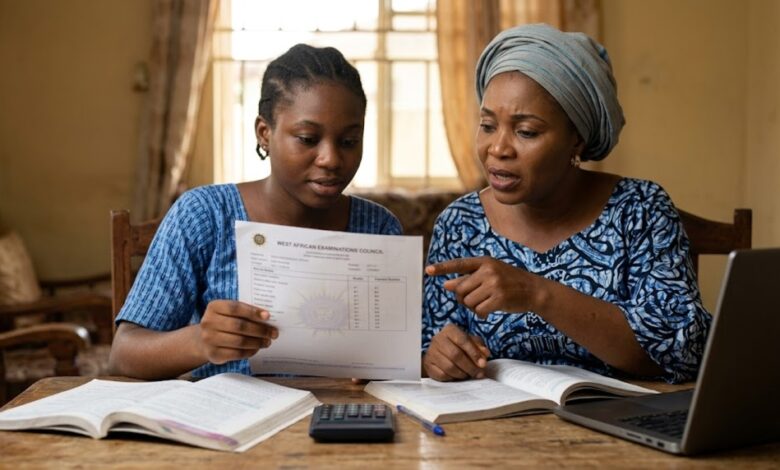
If you have ever bought a WAEC scratch card with trembling hands, or stared at your university portal wondering how your CGPA suddenly dropped, you already know the stress.
In Nigeria, the grading system is not just about numbers on a piece of paper. It is the “yardstick” that decides if you get that entry-level bank job, win a PTDF scholarship, or secure admission into a competitive federal university. It is the difference between a proud family thanksgiving and a very tense family meeting.
But whether you are a parent trying to track your child’s primary school progress, or an undergraduate trying to calculate your CGPA before your final year, the system can be confusing. From the 9-point WAEC scale to the strict 5.0 university scale, here is the real, on-the-ground breakdown of how grading works in Nigeria.
The “What You Need to Know” Summary
For the busy parent or student, here is the sharp-sharp gist:
- Primary School: Mostly percentage-based (70%+ is an A). But private schools are pushing the bar higher.
- Secondary School (WAEC/NECO): Uses a 9-point scale. A1 is the highest, F9 is a fail. You absolutely need at least a C6 in Math and English to even buy a JAMB form.
- Universities (NUC): Most use a 5.0 scale. 4.50+ is First Class, 3.50+ is Second Class Upper (2:1). Your 100-level grades matter more than you think.
- Polytechnics (NBTE): Uses a 4.0 scale. 3.00+ is an Upper Credit, which is the magic number for Direct Entry into universities.
- Colleges of Education (NCCE): Uses a unique grading system where 75%+ is a Distinction.
- Master’s Degree: The game changes. A 40% is no longer a pass; it is a fail. You need at least 50% (a ‘C’) to pass a Master’s course.
The 6-3-3-4 System: A Brief Background
Nigeria operates the 6-3-3-4 system of education: 6 years of primary school, 3 years of Junior Secondary (JSS), 3 years of Senior Secondary (SSS), and 4 years of tertiary education. This system was introduced to replace the old British-style GCE ‘O’ and ‘A’ level models, aiming to provide a more functional and locally relevant curriculum. Grading is the engine that moves students through these stages.
“What Grade Am I In?”: The US to Nigeria Translation
Let’s clear this up first. Thanks to foreign movies, internet culture, and the rise of international schools in places like Lekki and Maitama, many people now search for US grades. If you are a returnee parent relocating to Nigeria or just confused by the terms, here is how the American “Grade” system maps directly to the Nigerian 6-3-3-4 system:
- What is Grade 6 in Nigeria? Primary 6. (Usually ages 10-11).
- What is Grade 7 in Nigeria? JSS 1 (Junior Secondary School 1).
- What is Grade 8 in Nigeria? JSS 2.
- What is Grade 9 in Nigeria? JSS 3 (The crucial year you write Junior WAEC/BECE).
- What is Grade 10 in Nigeria? SSS 1 (Senior Secondary School 1).
- What is Grade 11 in Nigeria? SSS 2.
- What is Grade 12 in Nigeria? SSS 3 (Your final WAEC/NECO year).
- What is Grade 13 in Nigeria? We don’t have this. Grade 13 in the UK/US is equivalent to A-Levels, JUPEB, or your 100-Level in a Nigerian university.
Primary School Grading System in Nigeria
At the primary level, schools keep things relatively simple. The focus is on Continuous Assessment (CA)—which includes homework, class participation, and mid-term tests—and the final termly examination.
Usually, the CA takes 30% to 40% of the marks, while the exam takes 60% to 70%.
- A (Excellent): 70% and above
- B (Very Good): 60% – 69%
- C (Good): 50% – 59%
- D (Pass): 45% – 49%
- E (Fair): 40% – 44%
- F (Fail): Below 40%
The Real Gist: In modern private schools, the standard is much higher. Many top-tier schools won’t give an “A” unless a student scores 85% or 90% and above. This is also the stage where the famous Nigerian “Lesson Teacher” culture begins. Parents hire private tutors to ensure their kids score high enough to pass the National Common Entrance Examination (NCEE), the highly competitive gateway into elite Federal Unity Colleges like King’s College or Queens College.
Secondary School Grading System in Nigeria
This is where the stakes get incredibly high. Your secondary school grades literally dictate your admission chances through JAMB. No matter how high you score in JAMB, bad O’Level grades will keep you at home for another year.
Junior Secondary School (JSS 3) Grading
At the end of JSS 3, students write the Basic Education Certificate Examination (BECE), often handled by NECO or state educational boards. The NECO grading system for JSS3 uses simple letters. Passing this exam determines if a student will enter the Science, Arts, or Commercial class in SSS 1.
- A: Distinction
- C: Credit
- P: Pass
- F: Fail
Senior Secondary School (WAEC & NECO)
To move into a tertiary institution, you must pass your Senior School Certificate Examination (SSCE). Most students write the internal WAEC (May/June) and NECO (June/July). The grading system uses a strict 9-point scale.
| Grade | Numeric Value | Description | Percentage Range |
| A1 | 1 | Excellent | 75% – 100% |
| B2 | 2 | Very Good | 70% – 74% |
| B3 | 3 | Good | 65% – 69% |
| C4 | 4 | Credit | 60% – 64% |
| C5 | 5 | Credit | 55% – 59% |
| C6 | 6 | Credit | 50% – 54% |
| D7 | 7 | Pass | 45% – 49% |
| E8 | 8 | Pass | 40% – 44% |
| F9 | 9 | Fail | 0% – 39% |
Pro-Tip on Admission Points and “Two Sittings”: Many universities use your O’Level grades for admission screening points. An A1 gives you maximum points (e.g., 8 points) while a C6 gives you the bare minimum (e.g., 3 points). So, don’t just aim to “clear your papers.”
Also, while you can combine a WAEC result and a NECO result (called “Two Sittings”), highly competitive courses like Medicine and Surgery or Law in schools like UNILAG, UI, or UNILORIN often demand “One Sitting” only.
University Grading System in Nigeria (The NUC 5.0 Scale)
Once you enter the university, forget WAEC. You are now playing the Cumulative Grade Point Average (CGPA) game. The academic calendar is usually divided into two terms, affectionately called the Harmattan Semester (August to December) and the Rain Semester (January to July).
How does CGPA work? Your grade in each course is converted to a “Grade Point” (GP), which is then multiplied by the “Credit Load” (or Unit) of that course.
Most federal and state universities use the NUC 5.0 scale:
- A (70-100%): 5 Points
- B (60-69%): 4 Points
- C (50-59%): 3 Points
- D (45-49%): 2 Points
- E (40-44%): 1 Point
- F (0-39%): 0 Points
(Note: There was a brief period between 2017 and 2018 when the NUC experimented with a 4.0 scale, causing massive confusion. Most public universities have since reverted to the 5.0 scale. However, several private universities like Covenant or Babcock still run strictly on the 4.0 scale).
The 100-Level Trap and Continuous Assessment (CA)
Many freshers fall into the “freedom trap” in 100-level. They skip classes and ignore their Continuous Assessment (CA). In Nigerian universities, your CA (tests and assignments) makes up 30% or 40% of your final grade. If you skip tests, you are writing the main exam over 60%. Even if you are a genius, it becomes mathematically impossible to get an ‘A’.
How to Calculate Your GPA (A Quick Example)
Let’s say you took 3 courses in your first semester:
- Mathematics (3 Units): You scored 75% (Grade A = 5 points).
- Calculation: 3 units × 5 points = 15 Quality Points.
- English (2 Units): You scored 62% (Grade B = 4 points).
- Calculation: 2 units × 4 points = 8 Quality Points.
- Physics (3 Units): You scored 55% (Grade C = 3 points).
- Calculation: 3 units × 3 points = 9 Quality Points.
- Total Quality Points: 15 + 8 + 9 = 32
- Total Units: 3 + 2 + 3 = 8
- Your GPA: 32 ÷ 8 = 4.00
Degree Classifications (What Your Final Score Means)
When your final results are approved by the University Senate, your final CGPA puts you in a “Class.”
- First Class Honours (4.50 – 5.00): You are academic royalty. Automatic bragging rights, and often comes with automatic employment or scholarships.
- Second Class Upper / 2:1 (3.50 – 4.49): The “Sweet Spot.” This is the minimum requirement for most top-tier corporate jobs, bank Graduate Trainee roles, and “Big 4” accounting firms in Nigeria.
- Second Class Lower / 2:2 (2.40 – 3.49): The most common degree. If you fall here, you’ll need to back this up with hard tech skills, an amazing portfolio, or professional certs (like ICAN or CIPM) to compete fiercely.
- Third Class (1.50 – 2.39): You passed, but the corporate job market will be very hostile. You will likely need a Postgraduate Diploma (PGD) to “wash” the result before moving forward.
- The “Pass” Degree Phase-Out: The NUC heavily advised universities to discontinue awarding degrees below Third Class (0.99 – 1.49). In most modern Nigerian universities today, if your final CGPA is below 1.50, you simply will not graduate.
Polytechnic Grading System (NBTE Standards)
Polytechnics in Nigeria award the National Diploma (ND) and Higher National Diploma (HND). They do not use First Class or Second Class terminology. Instead, they use a 4.0 scale based on the National Board for Technical Education (NBTE) guidelines:
- Distinction: 3.50 – 4.00
- Upper Credit: 3.00 – 3.49
- Lower Credit: 2.50 – 2.99
- Pass: 2.00 – 2.49
Upper Credit vs. Lower Credit Meaning
What is the difference between upper credit and lower credit? Everything. If you finish your ND with an Upper Credit, you are highly eligible to buy a Direct Entry (DE) form and cross over into 200 Level in a university.
If you have a Lower Credit, gaining Direct Entry admission is extremely difficult. Most Lower Credit holders are forced to do their 1-year compulsory Industrial Training (IT) and then return to the polytechnic to complete their HND.
Colleges of Education Grading System (NCCE)
If you are attending a College of Education to get your National Certificate in Education (NCE), your grading is controlled by the National Commission for Colleges of Education (NCCE). The NCE is the minimum teaching qualification in Nigeria. The grading is unique and slightly stricter at the top end:
- A (75-100%): Distinction
- B (65-74%): Credit
- C (55-64%): Merit
- D (45-49%): Pass
- E (40-44%): Low Pass
- F (0-39%): Fail
Many NCE graduates use their results to gain Direct Entry into university degree programs (B.Ed or B.A. Ed). If you have a Distinction or Credit, your chances of crossing over seamlessly are very high.
Masters Degree Grading Scale in Nigeria
If you decide to push for your M.Sc. or MBA, brace yourself. The rules change completely.
In undergraduate studies, scoring 40% (an E) is a pass. In a Nigerian Master’s program, 40% is a failure. The minimum pass mark for a postgraduate course is usually 50% (a ‘C’).
Postgraduate grading is ruthless. You will face project defense panels that will grill you on every single methodology you used. To proceed to a PhD, many universities (like UI, ABU, or UNILAG) require you to hit a minimum CGPA of 4.0 (on a 5.0 scale) or at least 60% overall average in your Master’s coursework.
Global Equivalents
If your plan is to leave the country and you are sending your transcript abroad for evaluation (to platforms like WES for the US or Canada), don’t panic if your grades look “low” compared to American standards. Nigerian grading is notoriously strict. We rarely give out 95% in universities, and foreign evaluation bodies know this.
- UK System: A Nigerian First Class is a UK First Class. A Nigerian 2:1 is equivalent to a UK Upper Second Class. They align perfectly, making the UK a favorite destination for Nigerian postgraduates.
- US & Canada System (WES Evaluation): WES knows it is much harder to get an ‘A’ (70%+) in Nigeria than in North America (where an A is usually 90%+). Because of this, a strong Nigerian 2:1 often evaluates to a very competitive 3.3 to 3.7 GPA on the US/Canada 4.0 scale.
Frequently Asked Questions (FAQs)
1. Is a D7 a good grade in WAEC?
No. A D7 is a “Pass,” but it is virtually useless for university admission in core subjects. You cannot use a D7 in Mathematics or English Language to gain admission into any Nigerian university. You need at least a C6.
2. What is a “Carryover”?
If you score an ‘F’ in a university course, you have failed. You cannot move on and leave it behind. You must register for that exact course again in the next academic year, attend the classes (if they don’t clash), and rewrite the exam. This is the fastest way to ruin a good CGPA.
3. What happens if I have a “Missing Grade”?
This is a classic Nigerian university problem. You wrote the exam, but your portal shows no score. You must immediately report this to your course rep and the lecturer with proof of attendance. Never leave a missing grade unresolved; the system will eventually calculate it as an ‘F’.
4. Lower credit is equivalent to what in the university?
An ND Lower Credit is roughly equivalent to a Second Class Lower (2:2) or a Third Class in the university system. It shows you passed, but not strongly enough to earn automatic progression to higher levels like Direct Entry without supplementary exams or highly specific school waivers.
5. How do I calculate my admission cut-off mark?
While every school is different, most calculate your aggregate by dividing your JAMB score by 8, and your Post-UTME score by 2. They add both figures together to get your final aggregate over 100.
6. What is Grade 8 in Nigeria?
In the international standard, Grade 8 is the exact equivalent of Junior Secondary School 2 (JSS 2) in the Nigerian system.
The Nigerian grading system is designed to test resilience as much as intelligence. Whether you are aiming for A1s in WAEC, an Upper Credit in your polytechnic, or fighting off carryovers to maintain a 2:1, the goal is consistent effort. Start tracking your scores early, and don’t let the math surprise you on graduation day!