Second Class CGPA: Everything You Need to Know About Nigeria’s Most Common Degree Rank
Nigeria's Most Common Degree Rank

Second class CGPA is the reality for the vast majority of Nigerian graduates, yet it remains the most debated degree classification. Picture this: You just printed your NYSC call-up letter. You are heading to camp, but at the back of your mind, you are already calculating how your final result will hold up in the fierce Lagos or Abuja job market.
In the Nigerian university system, your Cumulative Grade Point Average (CGPA) is not just an academic record. It is the immediate filter HR managers use when 5,000 people apply for 20 Graduate Trainee slots.
Whether you are aiming for an Upper or trying to survive a Lower, you need absolute clarity on where you stand. Is a 2:2 really a career death sentence? Exactly what point is second class upper in the eyes of top-tier employers? No stories. Let’s break down the math, the reality, and the street-smart ways to navigate your academic ranking on both the 5.0 and 4.0 scales.
The “What You Need to Know” Summary
For the busy reader, here are the hard numbers based on the National Universities Commission (NUC) benchmark and private university standards:
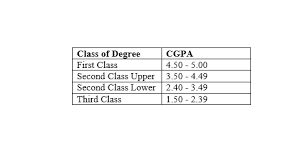
- The 5.0 Scale Benchmark: In most Nigerian public universities, a Second Class degree generally falls between 2.40 and 4.49.
- The 4.0 Scale Benchmark: For many private universities, a Second Class degree spans from 2.50 to 3.49.
- What is the CGPA for Second Class Upper? It is strictly 3.50 to 4.49 (on a 5.0 scale) or 3.00 to 3.49 (on a 4.0 scale).
- What CGPA is Second Class Lower? It falls between 2.40 and 3.49 (on a 5.0 scale) or 2.50 to 2.99 (on a 4.0 scale).
- The Borderline Reality: In the Nigerian system, 3.49 (on a 5.0 scale) is a Second Class Lower. The system does not “round up” to 3.50.
The NUC Standard: Second Class Upper CGPA in Nigeria
If you are asking, “what point is second class upper?”, you need to look at the unified standard set by the National Universities Commission (NUC).
Back in the day, grading was a bit chaotic. ABU Zaria might grade differently from UNILAG. To fix this, the NUC mandated a standardized 5.0 scale for federal and state universities.
Under this system, the second class upper cgpa in Nigeria spans from 3.50 to 4.49.
The 4.0 Scale Exception (Private Universities & Polytechnics)
But there is a catch. Many private universities in Nigeria (like Covenant University, Babcock, or Bowen) and several polytechnics operating under NBTE guidelines heavily mirror the American system and operate on a 4.0 scale.
If your school uses a maximum of 4.0, the breakdown changes entirely. Here is what the classes look like on a 4.0 scale:
- First Class: 3.50 – 4.00
- Second Class Upper (2:1): 3.00 – 3.49
- Second Class Lower (2:2): 2.50 – 2.99
- Third Class: 2.00 – 2.49
Pro-Tip: Always check your specific student handbook. HR departments in top banks are fully aware of these conversions. If you apply for a job that requires a 2:1 and you submit a 3.20 CGPA from Covenant University, they know you met the requirement, even though it looks like a 2:2 on the federal 5.0 scale.
What is Second Class Upper CGPA? (2:1 Degree)
The Second Class Upper (2:1) is the absolute gold standard for entry-level corporate jobs in Nigeria. Whether it is a 3.50+ on a 5.0 scale or a 3.00+ on a 4.0 scale, it tells an employer that you are highly disciplined, but you also had enough free time to build social skills, unlike the stereotype of First Class students who “only know books.”
Why the 2:1 Matters
- The Graduate Trainee Filter: Commercial banks (GTBank, Access Bank) and the “Big 4” accounting firms (PwC, KPMG, EY, Deloitte) have a strict 2:1 minimum cut-off. It is simply a crowd-control mechanism. With a 2:1, you easily cross this first hurdle.
- Federal and Oil & Gas Jobs: Want to work at NLNG, Chevron, or get a PTDF scholarship? A 2:1 is usually the bare minimum requirement to even submit your application.
- Masters Degree Abroad: If you want to study in the UK, a Nigerian 2:1 easily translates to a British “Upper Second” (60% – 69%), making you eligible for almost any Masters program without needing a pre-masters or Postgraduate Diploma (PGD).
What is Second Class Lower CGPA? (The 2:2 Reality)
Now, let’s address the most searched question: what gpa is second class lower?
Depending on your school’s grading system:
- On the standard NUC 5.0 scale, a Second Class Lower falls strictly between 2.40 and 3.49.
- On the private university 4.0 scale, it falls between 2.50 and 2.99. It is famously referred to across all campuses as a “Two-Two.”
Is Second Class Lower a Bad Result?
Let’s be brutally honest. No, it is not a bad result. But it does change the way you have to play the game.
Many brilliant students end up with a 2:2 because of ASUU strikes that disrupted their momentum, missing a test due to Lagos traffic, or simply struggling in their 100 level before they understood how university works.
If you graduate with a 2:2, here is the on-the-ground reality:
- The Corporate Door is Narrower: You will be automatically screened out of standard entry-level bank jobs. Sending your CV to those specific portals is often a waste of data.
- Skills Over Paper: This is where you pivot. The tech industry (software engineering, data analysis, UI/UX design) and the creative sector do not care about your degree class. If your portfolio is solid, a 2:2 graduate with hard skills will easily out-earn a 2:1 graduate waiting for a bank job.
- Professional Certifications are Mandatory: If you studied Accounting or Business and have a 2:2, you must write your ICAN, ACCA, or CIPM exams immediately. A 2:2 graduate who is a Chartered Accountant is infinitely more employable than a 2:1 graduate with zero professional certifications.
GPA vs. CGPA: Don’t Confuse the Two
If you are still in school, you need to know the difference between these two terms to avoid “stories that touch” in your final year.
- GPA (Grade Point Average): This is the calculation for one specific semester. It measures your performance for just those 3 or 4 months.
- CGPA (Cumulative Grade Point Average): This is the heavyweight. It is the continuous average of all your semesters combined, from 100 level day one, up to your final defense. Your final CGPA dictates your degree classification.
How to Calculate Your CGPA (The Math That Matters)
To understand exactly what point is second class upper, you need to know how the points are allocated.
The Formula: CGPA = (Total Quality Points) ÷ (Total Credit Units)
The NUC Grading System (5.0 Scale)
- A (70% – 100%): 5 points
- B (60% – 69%): 4 points
- C (50% – 59%): 3 points
- D (45% – 49%): 2 points
- E (40% – 44%): 1 point
- F (0% – 39%): 0 points
The “Credit Unit” Hustle
This is where many students fail. All courses are not created equal.
If you get an ‘A’ in a massive 4-unit course (like advanced engineering math), you secure 20 Quality Points (5 points x 4 units).
If you get an ‘A’ in a 1-unit course (like a basic GST), you only get 5 Quality Points (5 points x 1 unit).
Pro-Tip: If your CGPA is dropping, stop stressing over 1-unit courses. Channel 80% of your reading energy into passing your 3-unit and 4-unit core courses. That is how you lift your overall average fast.
The “Senate Borderline” Reality: The 3.49 Trap
There is a massive psychological difference between a 3.49 and a 3.50 (on a 5.0 scale), or a 2.99 and a 3.00 (on a 4.0 scale).
Many students finish their final exams, calculate their CGPA, see 3.49, and assume the school Senate will “round it up” to a 3.50 so they can get a 2:1.
In federal and state universities in Nigeria, this does not happen. 3.499 is mathematically a Second Class Lower. Your class of degree is determined by raw data, not rounding. This is why fighting for every single mark in your Continuous Assessment (CA) is a matter of life and death for your final result.
Global Equivalents: Japa Plans and Your CGPA
If your plan after NYSC is to leave the country for a Masters, here is how the Nigerian system translates abroad:
| Country | Local Scale | 2:1 (Upper) Equivalent | 2:2 (Lower) Equivalent |
| Nigeria | 5.0 Scale | 3.50 – 4.49 | 2.40 – 3.49 |
| Nigeria (Private) | 4.0 Scale | 3.00 – 3.49 | 2.50 – 2.99 |
| USA | 4.0 Scale | ~3.3 – 3.7 | ~2.7 – 3.0 |
| UK | Percentage (%) | 60% – 69% | 50% – 59% |
| Canada | 4.0 Scale | 3.0 – 3.3 | 2.3 – 2.7 |
Note: If you have a 2:2 and want to study in the UK or Canada, you are not stranded. Many schools will accept a 2:2 if you have 2 to 3 years of solid, provable work experience in a related field.
The Final Gist
Your degree classification is a tool, not your entire destiny. A Second Class Upper makes the first two years after graduation much easier because corporate doors open faster. A Second Class Lower means you have to kick the doors open yourself using hard skills, networking, and professional exams.
Track your grades early, respect your high-unit courses, and remember that five years after graduation, employers care far more about the value you bring to the table than the numbers printed on your certificate.
Frequently Asked Questions (FAQs)
1. What cgpa is for second class upper exactly?
On the NUC 5.0 scale used by most Nigerian public universities, a Second Class Upper is from 3.50 to 4.49. On the 4.0 scale used by private universities, it is from 3.00 to 3.49.
2. Is a 3.45 CGPA a Second Class Upper?
No. If your school uses a 5.0 scale, a 3.45 falls under the 2.40 – 3.49 bracket, making it a Second Class Lower (2:2). You must hit at least 3.50 to cross into the Upper division. (However, on a 4.0 scale, a 3.45 is a strong 2:1).
3. What is second class lower gpa equivalent to in the USA?
Because the USA uses a 4.0 scale, a Nigerian Second Class Lower (2:2) roughly translates to a GPA between 2.7 and 3.0.
4. Can I get a bank job with a Second Class Lower?
It is very difficult to get into standard Graduate Trainee programs in commercial banks with a 2:2. However, you can enter the banking sector through alternative routes like IT, specialized tech roles, or by starting in a microfinance bank and building your experience.
5. How can I upgrade my 2:2 to apply for a competitive Masters?
If a university requires a 2:1 and you have a 2:2, your best route in Nigeria is to enroll for a Postgraduate Diploma (PGD). Completing a PGD with strong grades effectively “washes” your 2:2 and qualifies you for competitive Master’s programs.
